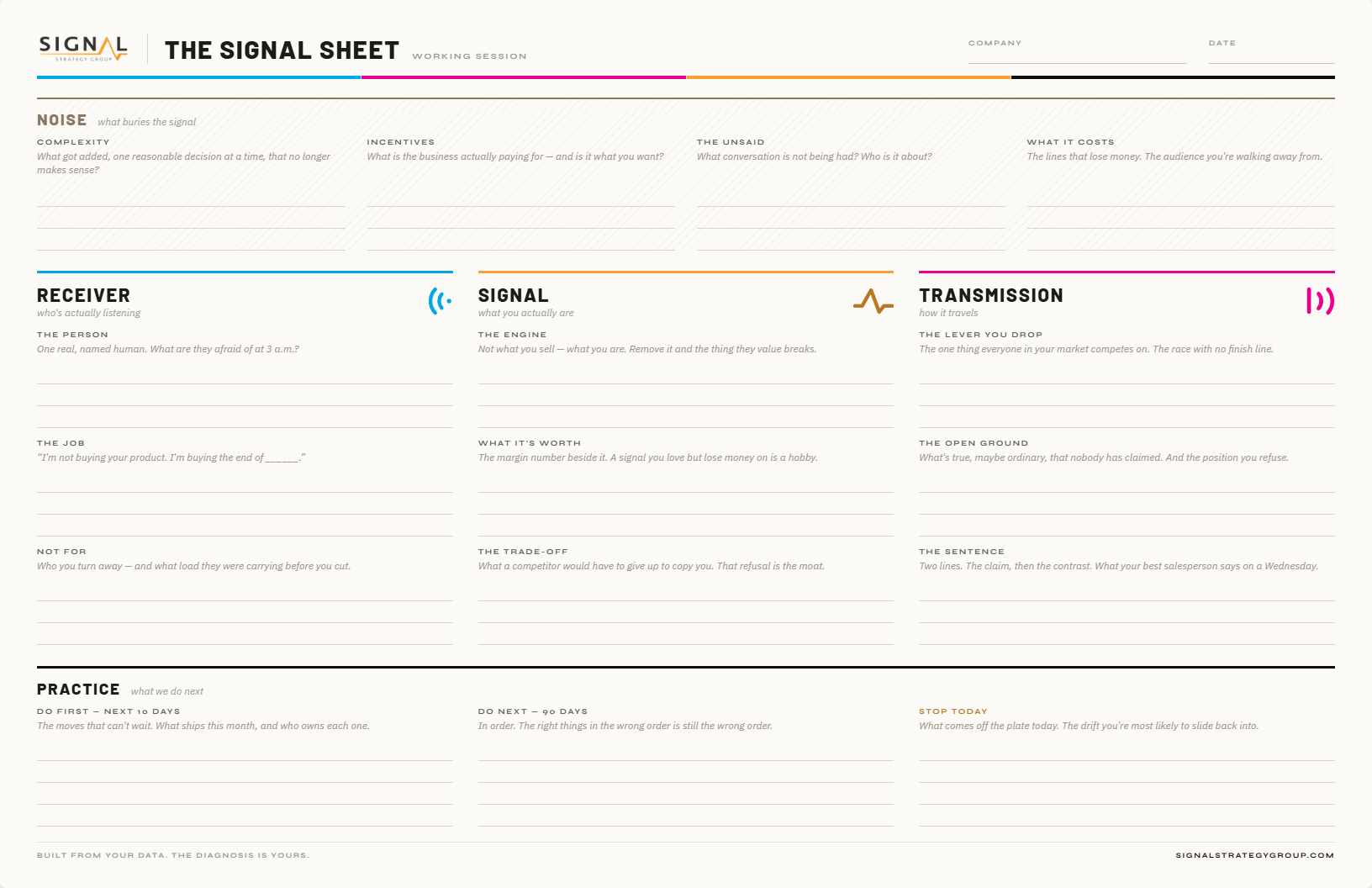
What the Signal Sheet is.
The Signal Sheet is a free 11×17 working sheet from Signal Strategy Group. Five zones: the noise you can't defend, then Receiver, Signal and Transmission across the middle, then what happens Monday. It's designed for one session with your leadership team, in pencil, on a wall. There's also a 36×48 board sized for sticky notes.
Five zones, in the order the argument runs.
Noise first, because you can't hear anything until you name what's in the way. Then the three bands. Then what you're doing about it before anyone leaves the room.
Noise
what buries the signal
Everything that got added one reasonable decision at a time. This zone is deliberately the ugliest thing on the sheet.
What got added that no longer makes sense.
What the business is actually paying for.
The conversation nobody is having, and who it is about.
The lines that lose money. The audience you are walking away from.
Receiver
who's actually listening
One real, named human — not the persona on your wall.
What they are actually hiring you to end.
Who you turn away, and what load they were carrying.
Signal
what you actually are
Remove it and the thing they value breaks.
The margin number beside it. A signal you lose money on is a hobby.
What a competitor would have to give up to copy you.
Transmission
how it travels
The thing everyone in your market competes on.
What is true, maybe ordinary, that nobody has claimed.
Two lines. The claim, then the contrast.
Practice
what we do next
A diagnosis nobody acts on is a nice afternoon. This band is the only part with names and dates on it.
The moves that cannot wait, and who owns each one.
In order. The right things in the wrong order is still the wrong order.
What comes off the plate, and the drift you will slide back into.
How to run it.
Two ways, and the second one is the point. The sheet is small enough to fill alone and big enough to argue over.
One sitting, in pencil
Start at Noise and go left to right. Don't skip a box because you don't know — write what you'd guess and put a circle around it. The circles are the map of what you don't actually know about your own business.
Everyone fills it separately first
Print one per person. Nobody talks for the first forty minutes. Then put them side by side. Six sheets that disagree about who the customer is will tell you more in ten minutes than a quarter of dashboards.
Read across, not down
The finding is almost never inside one band. It's the seam — what you say you are, next to what she's actually buying, next to what the market hears. Where those three stop agreeing is the diagnosis.
If every box fills in easily and nothing contradicts, you filled it in too politely. Do it again with the P&L open.
Specific enough to be wrong.
Three real answers from real sheets, lightly disguised. Notice that none of them could be said by a competitor, and all of them could be argued with.
One real, named human. What are they afraid of at 3 a.m.?
An exhausted parent who is not artsy, does not know where to start, and needs one thing on the list to be handled by someone she trusts.
What a competitor would have to give up to copy you. That refusal is the moat.
Everyone in the category promises mastery. We refuse to, because the promise manufactures the dropout. A competitor cannot copy that without calling their own pitch a lie.
Two lines. The claim, then the contrast.
A real teacher is waiting for your child, live, every week. Not a video library with nobody home.
Want it in your inbox instead?
We'll send the sheet plus a short note on what to look for the first time you run it. Nothing else. No sequence, no drip.

Ready to find your signal?
Start with the assessment. See what the data says.